Blackberry Silver Dollar - Myloplus schomburgkii
Blackberry Silver Dollar (Myloplus schomburgkii)
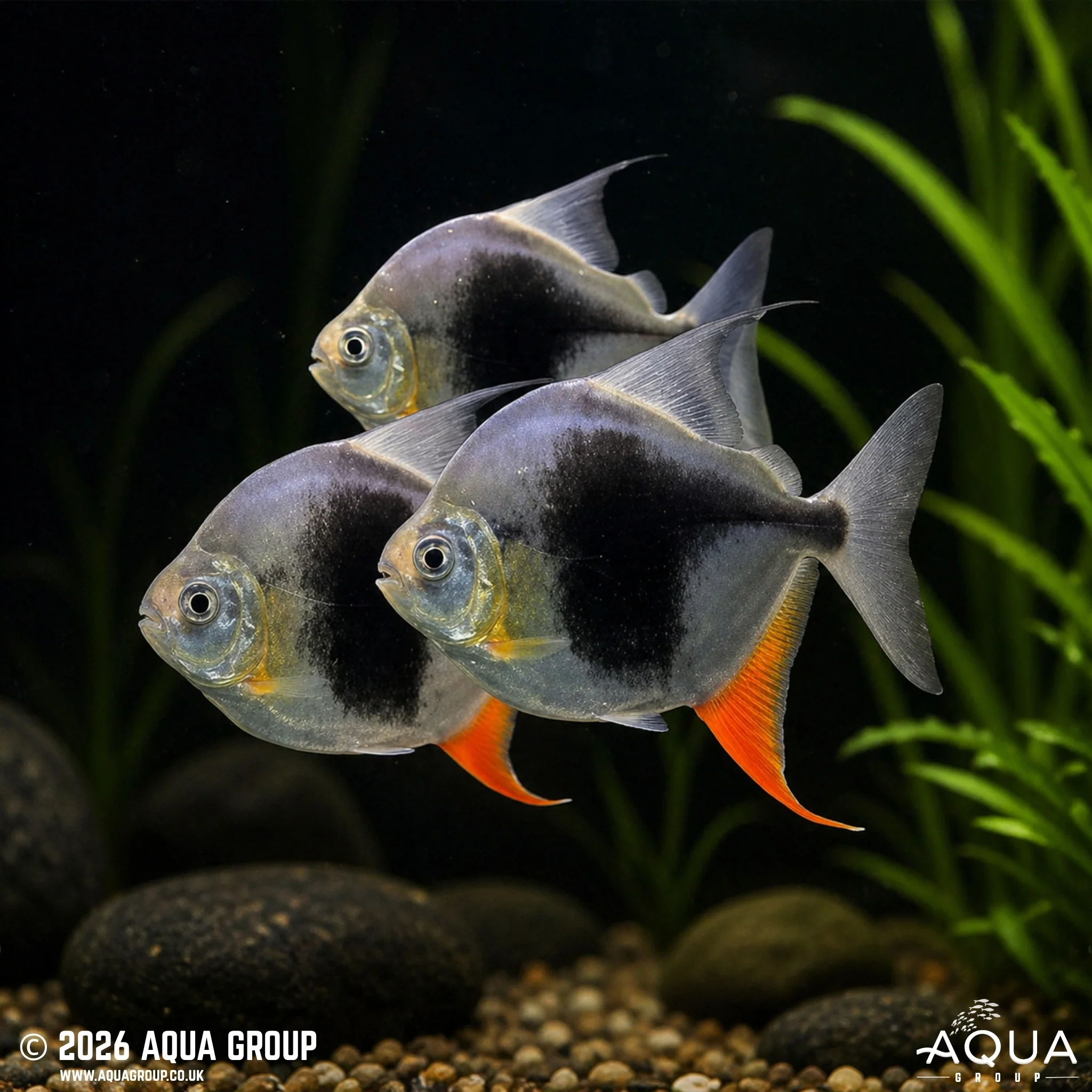
The Blackberry Silver Dollar is a rare and highly striking colour form of the Black Barred Silver Dollar, prized for its deep blackberry-blue to dark charcoal body tones, bold darker flank marking and rich red colouration through the fins. It is a large, fast-moving shoaling characin that makes an impressive feature fish in a spacious freshwater aquarium. Although generally peaceful, this is not a small community fish — it needs room, company of its own kind and carefully chosen tank mates.
Common Name:
Blackberry Silver Dollar. Also commonly sold as the Blackberry Myleus, Black Barred Silver Dollar, Black Belt Silver Dollar or Black-barred Myleus.
Scientific Name (Latin):
Myloplus schomburgkii
Often also seen in older aquarium references as Myleus schomburgkii.
Maximum Size:
The true species can reach around 30–40 cm, with FishBase listing up to 42 cm standard length. Some Blackberry trade strains are sold as growing smaller, but the safer long-term recommendation is to plan for a large adult fish.
Water Type:
Freshwater
Origin / Natural Habitat:
The Blackberry Silver Dollar is generally regarded as a selectively bred or aquacultured colour form, with trade references pointing to Asian aquaculture. The wild form of Myloplus schomburgkii is native to South America, including parts of the Amazon and Orinoco systems. In nature, related black-barred Myloplus are associated with warm tropical rivers and floodplain habitats, often in areas with vegetation, current and seasonal food availability.
Water Parameters:
Temperature: 23–27°C
pH Range: 5.5–7.2
Hardness: soft to moderately hard water, with softer, slightly acidic water preferred long-term
Temperament:
Generally peaceful for its size, but very active, powerful and easily startled. It should not be kept with very small fish, slow delicate species or anything that may be intimidated by a fast-moving shoal of large silver dollars.
Diet:
Omnivorous with a strong herbivorous tendency. It should be offered a varied diet including quality pellets, granules, algae wafers, spirulina foods, vegetable matter, leafy greens and occasional frozen foods. It may also accept fruit-style foods in small amounts. Most soft aquarium plants are likely to be eaten.
Minimum Tank Size:
A practical long-term recommendation is at least 600 litres for a group, with a 6ft aquarium or larger strongly preferred. Juveniles may be grown on in smaller aquariums, but they are fast swimmers and should not be underestimated.
Behaviour & Activity:
This is a shoaling mid-water fish that should be kept in a group of at least 5–6 individuals. It is fast, alert and can be nervous if kept alone or in a busy, exposed aquarium. A larger group helps spread hierarchy, reduce stress and create a more natural display. It needs open swimming space, subdued lighting, smooth décor and a secure lid, as startled fish may jump or crash into hard objects.
Aquarium Category:
Community Fish
This species is peaceful enough for a large-species community aquarium, but only with suitable tank mates. Best kept with other larger peaceful fish such as big characins, larger peaceful cichlids, robust catfish, plecos and similar-sized non-aggressive species. Avoid nano fish, fin nippers, very shy species and heavily planted aquariums with delicate plants.
Special Requirements or Care Notes:
Best kept in a spacious, mature aquarium with excellent filtration, strong oxygenation and stable water quality. This species is sensitive to poor water conditions and should not be kept in cramped tanks. Décor should be smooth and arranged to leave plenty of open swimming room. Use hardy plants such as Anubias or Java Fern if attempting a planted layout, but expect most soft plants to be grazed or destroyed.
Suitable for:
Intermediate to experienced fishkeepers
Availability:
Rare / occasional in trade
All images are a visual representation of the fish you will receive, made to be as accurate as possible. Please note that Mother Nature is a wonderful thing, and variation in patterns and colours will occur — that is part of the unique beauty of these animals.
Product Information
Product Information
Shipping & Returns
Shipping & Returns
Blackberry Silver Dollar - Myloplus schomburgkii
Blackberry Silver Dollar - Myloplus schomburgkii
Blackberry Silver Dollar (Myloplus schomburgkii)
The Blackberry Silver Dollar is a rare and highly striking colour form of the Black Barred Silver Dollar, prized for its deep blackberry-blue to dark charcoal body tones, bold darker flank marking and rich red colouration through the fins. It is a large, fast-moving shoaling characin that makes an impressive feature fish in a spacious freshwater aquarium. Although generally peaceful, this is not a small community fish — it needs room, company of its own kind and carefully chosen tank mates.
Common Name:
Blackberry Silver Dollar. Also commonly sold as the Blackberry Myleus, Black Barred Silver Dollar, Black Belt Silver Dollar or Black-barred Myleus.
Scientific Name (Latin):
Myloplus schomburgkii
Often also seen in older aquarium references as Myleus schomburgkii.
Maximum Size:
The true species can reach around 30–40 cm, with FishBase listing up to 42 cm standard length. Some Blackberry trade strains are sold as growing smaller, but the safer long-term recommendation is to plan for a large adult fish.
Water Type:
Freshwater
Origin / Natural Habitat:
The Blackberry Silver Dollar is generally regarded as a selectively bred or aquacultured colour form, with trade references pointing to Asian aquaculture. The wild form of Myloplus schomburgkii is native to South America, including parts of the Amazon and Orinoco systems. In nature, related black-barred Myloplus are associated with warm tropical rivers and floodplain habitats, often in areas with vegetation, current and seasonal food availability.
Water Parameters:
Temperature: 23–27°C
pH Range: 5.5–7.2
Hardness: soft to moderately hard water, with softer, slightly acidic water preferred long-term
Temperament:
Generally peaceful for its size, but very active, powerful and easily startled. It should not be kept with very small fish, slow delicate species or anything that may be intimidated by a fast-moving shoal of large silver dollars.
Diet:
Omnivorous with a strong herbivorous tendency. It should be offered a varied diet including quality pellets, granules, algae wafers, spirulina foods, vegetable matter, leafy greens and occasional frozen foods. It may also accept fruit-style foods in small amounts. Most soft aquarium plants are likely to be eaten.
Minimum Tank Size:
A practical long-term recommendation is at least 600 litres for a group, with a 6ft aquarium or larger strongly preferred. Juveniles may be grown on in smaller aquariums, but they are fast swimmers and should not be underestimated.
Behaviour & Activity:
This is a shoaling mid-water fish that should be kept in a group of at least 5–6 individuals. It is fast, alert and can be nervous if kept alone or in a busy, exposed aquarium. A larger group helps spread hierarchy, reduce stress and create a more natural display. It needs open swimming space, subdued lighting, smooth décor and a secure lid, as startled fish may jump or crash into hard objects.
Aquarium Category:
Community Fish
This species is peaceful enough for a large-species community aquarium, but only with suitable tank mates. Best kept with other larger peaceful fish such as big characins, larger peaceful cichlids, robust catfish, plecos and similar-sized non-aggressive species. Avoid nano fish, fin nippers, very shy species and heavily planted aquariums with delicate plants.
Special Requirements or Care Notes:
Best kept in a spacious, mature aquarium with excellent filtration, strong oxygenation and stable water quality. This species is sensitive to poor water conditions and should not be kept in cramped tanks. Décor should be smooth and arranged to leave plenty of open swimming room. Use hardy plants such as Anubias or Java Fern if attempting a planted layout, but expect most soft plants to be grazed or destroyed.
Suitable for:
Intermediate to experienced fishkeepers
Availability:
Rare / occasional in trade
All images are a visual representation of the fish you will receive, made to be as accurate as possible. Please note that Mother Nature is a wonderful thing, and variation in patterns and colours will occur — that is part of the unique beauty of these animals.
Original: $40.60
-65%$40.60
$14.21Product Information
Product Information
Shipping & Returns
Shipping & Returns
Description
Blackberry Silver Dollar (Myloplus schomburgkii)
The Blackberry Silver Dollar is a rare and highly striking colour form of the Black Barred Silver Dollar, prized for its deep blackberry-blue to dark charcoal body tones, bold darker flank marking and rich red colouration through the fins. It is a large, fast-moving shoaling characin that makes an impressive feature fish in a spacious freshwater aquarium. Although generally peaceful, this is not a small community fish — it needs room, company of its own kind and carefully chosen tank mates.
Common Name:
Blackberry Silver Dollar. Also commonly sold as the Blackberry Myleus, Black Barred Silver Dollar, Black Belt Silver Dollar or Black-barred Myleus.
Scientific Name (Latin):
Myloplus schomburgkii
Often also seen in older aquarium references as Myleus schomburgkii.
Maximum Size:
The true species can reach around 30–40 cm, with FishBase listing up to 42 cm standard length. Some Blackberry trade strains are sold as growing smaller, but the safer long-term recommendation is to plan for a large adult fish.
Water Type:
Freshwater
Origin / Natural Habitat:
The Blackberry Silver Dollar is generally regarded as a selectively bred or aquacultured colour form, with trade references pointing to Asian aquaculture. The wild form of Myloplus schomburgkii is native to South America, including parts of the Amazon and Orinoco systems. In nature, related black-barred Myloplus are associated with warm tropical rivers and floodplain habitats, often in areas with vegetation, current and seasonal food availability.
Water Parameters:
Temperature: 23–27°C
pH Range: 5.5–7.2
Hardness: soft to moderately hard water, with softer, slightly acidic water preferred long-term
Temperament:
Generally peaceful for its size, but very active, powerful and easily startled. It should not be kept with very small fish, slow delicate species or anything that may be intimidated by a fast-moving shoal of large silver dollars.
Diet:
Omnivorous with a strong herbivorous tendency. It should be offered a varied diet including quality pellets, granules, algae wafers, spirulina foods, vegetable matter, leafy greens and occasional frozen foods. It may also accept fruit-style foods in small amounts. Most soft aquarium plants are likely to be eaten.
Minimum Tank Size:
A practical long-term recommendation is at least 600 litres for a group, with a 6ft aquarium or larger strongly preferred. Juveniles may be grown on in smaller aquariums, but they are fast swimmers and should not be underestimated.
Behaviour & Activity:
This is a shoaling mid-water fish that should be kept in a group of at least 5–6 individuals. It is fast, alert and can be nervous if kept alone or in a busy, exposed aquarium. A larger group helps spread hierarchy, reduce stress and create a more natural display. It needs open swimming space, subdued lighting, smooth décor and a secure lid, as startled fish may jump or crash into hard objects.
Aquarium Category:
Community Fish
This species is peaceful enough for a large-species community aquarium, but only with suitable tank mates. Best kept with other larger peaceful fish such as big characins, larger peaceful cichlids, robust catfish, plecos and similar-sized non-aggressive species. Avoid nano fish, fin nippers, very shy species and heavily planted aquariums with delicate plants.
Special Requirements or Care Notes:
Best kept in a spacious, mature aquarium with excellent filtration, strong oxygenation and stable water quality. This species is sensitive to poor water conditions and should not be kept in cramped tanks. Décor should be smooth and arranged to leave plenty of open swimming room. Use hardy plants such as Anubias or Java Fern if attempting a planted layout, but expect most soft plants to be grazed or destroyed.
Suitable for:
Intermediate to experienced fishkeepers
Availability:
Rare / occasional in trade
All images are a visual representation of the fish you will receive, made to be as accurate as possible. Please note that Mother Nature is a wonderful thing, and variation in patterns and colours will occur — that is part of the unique beauty of these animals.