Red Firefish - Nemateleotris magnifica
Red Firefish (Nemateleotris magnifica)
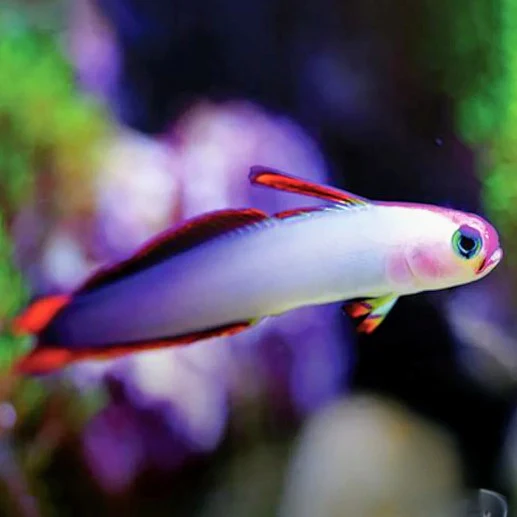
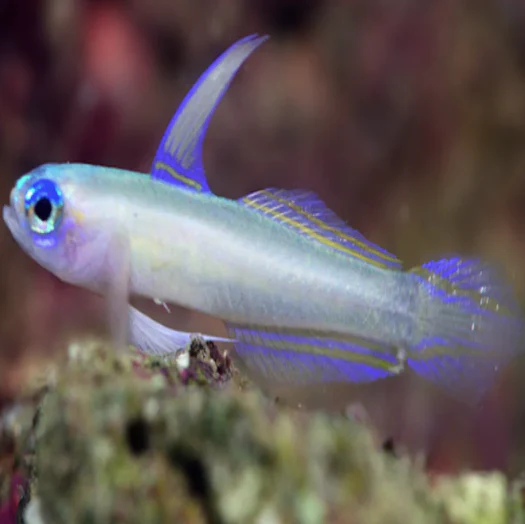
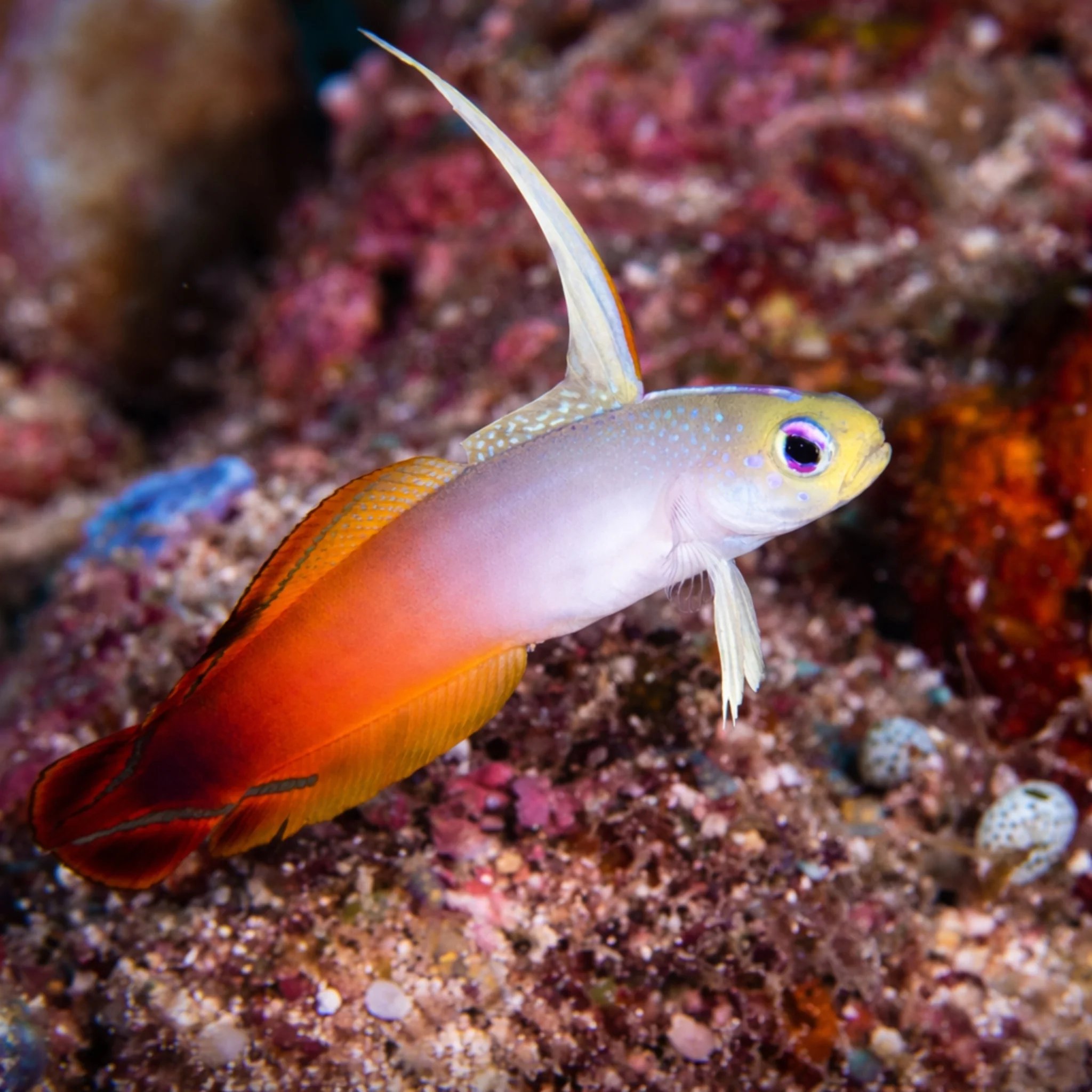
The Red Firefish is a graceful, vividly coloured dartfish with a pale front half that fades into fiery orange-red towards the rear, finished with a long, pennant-like dorsal fin. In the wild it inhabits outer reef slopes and hovers above the substrate facing into the current while feeding on zooplankton. It is peaceful, elegant and very well suited to reef aquaria, but it can be shy when first introduced and is well known for jumping if startled.
Common Name:
Red Firefish. It is also commonly known as the Firefish, Fire Goby or Fire Dartfish.
Scientific Name (Latin):
Nemateleotris magnifica
Maximum Size:
Up to 8–9 cm in length.
Water Type:
Marine.
Origin / Natural Habitat:
Found across the Indian and Pacific Oceans, including reef habitats where it occupies the upper portions of outer reef slopes and nearby sandy areas. It typically hovers close to a chosen hole or refuge and darts back to safety when threatened.
Water Parameters:
Temperature: 23–27°C
pH Range: 8.0–8.4
Salinity: 1.020–1.025 SG
Temperament:
Peaceful, though it may become defensive towards its own kind unless kept as a genuine pair or in a very large aquarium. It is best housed with other calm, non-aggressive fish.
Diet:
Carnivorous / planktivorous. It naturally feeds on zooplankton, copepods and crustacean larvae, and in captivity does best on a varied diet of small meaty foods such as mysis, enriched brineshrimp and other plankton-sized fare.
Minimum Tank Size:
75–200 litres depending on setup, but around 100 litres or more is a sensible practical recommendation for long-term care, especially in a reef aquarium where stable conditions and secure cover matter. Sources differ, with some listing smaller nano-style minimums and others recommending roughly 200 litres.
Behaviour & Activity:
A hovering mid-water species that spends much of the day suspended above the bottom, often near a bolt-hole. Juveniles may occur in groups, while adults more often form monogamous pairs and defend a chosen refuge.
Reef Safe:
Reef Safe
This species is widely regarded as safe with corals and ornamental invertebrates, making it an excellent choice for peaceful reef aquaria.
Special Requirements or Care Notes:
A tight-fitting lid is essential, as this species is a known jumper. It does best in a well-established marine aquarium with gentle tankmates, stable water quality and plenty of crevices or small caves for security. Newly introduced specimens can be shy, so a calm environment helps them settle.
Suitable for:
Beginner to Intermediate marine keepers. It is generally considered hardy and suitable for most reef aquaria, but its shy nature and jumping risk mean a little preparation goes a long way.
Availability:
Regular in trade. It is one of the more commonly kept dartfish in marine aquaria and is widely offered through the hobby.
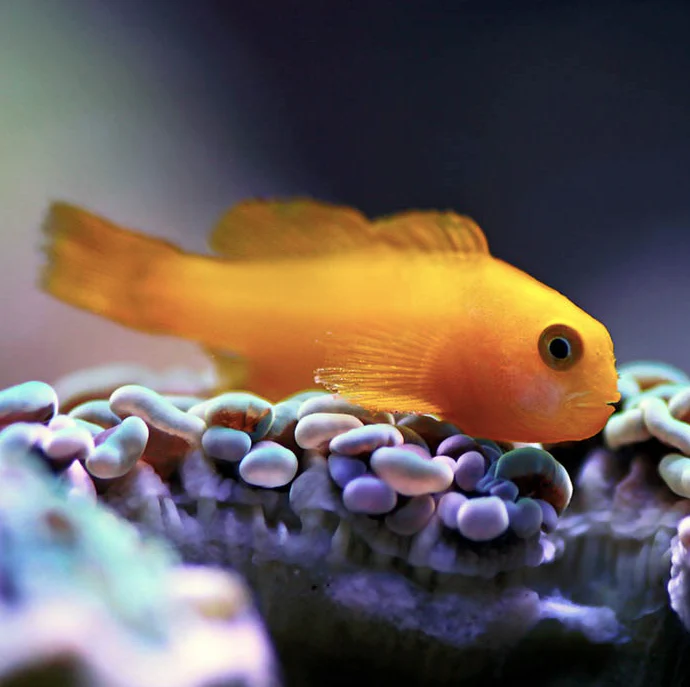
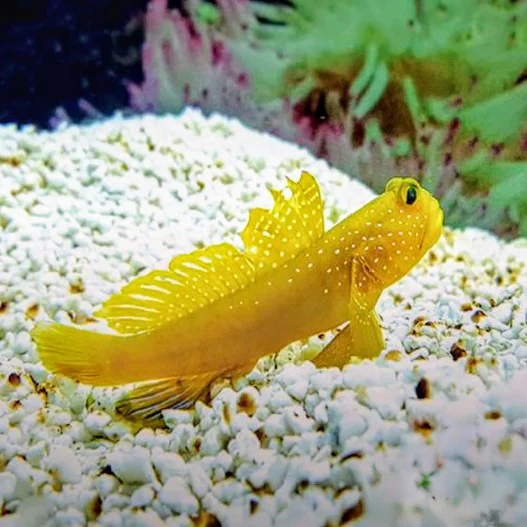
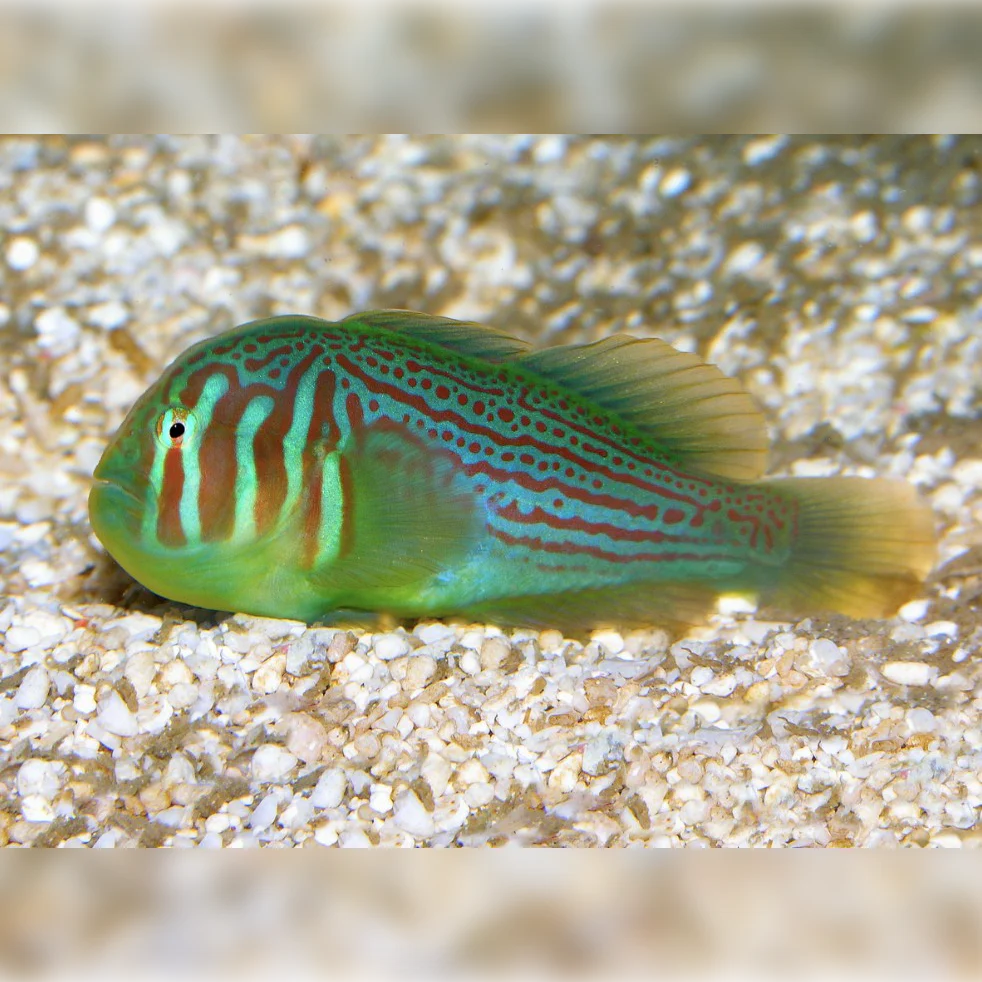
All images are a visual representation of the fish you will receive, made to be as accurate as possible. Please note that Mother Nature is a wonderful thing, and variation in patterns and colours will occur — that is part of the unique beauty of these animals.
Product Information
Product Information
Shipping & Returns
Shipping & Returns
Red Firefish - Nemateleotris magnifica
Red Firefish - Nemateleotris magnifica
Red Firefish (Nemateleotris magnifica)
The Red Firefish is a graceful, vividly coloured dartfish with a pale front half that fades into fiery orange-red towards the rear, finished with a long, pennant-like dorsal fin. In the wild it inhabits outer reef slopes and hovers above the substrate facing into the current while feeding on zooplankton. It is peaceful, elegant and very well suited to reef aquaria, but it can be shy when first introduced and is well known for jumping if startled.
Common Name:
Red Firefish. It is also commonly known as the Firefish, Fire Goby or Fire Dartfish.
Scientific Name (Latin):
Nemateleotris magnifica
Maximum Size:
Up to 8–9 cm in length.
Water Type:
Marine.
Origin / Natural Habitat:
Found across the Indian and Pacific Oceans, including reef habitats where it occupies the upper portions of outer reef slopes and nearby sandy areas. It typically hovers close to a chosen hole or refuge and darts back to safety when threatened.
Water Parameters:
Temperature: 23–27°C
pH Range: 8.0–8.4
Salinity: 1.020–1.025 SG
Temperament:
Peaceful, though it may become defensive towards its own kind unless kept as a genuine pair or in a very large aquarium. It is best housed with other calm, non-aggressive fish.
Diet:
Carnivorous / planktivorous. It naturally feeds on zooplankton, copepods and crustacean larvae, and in captivity does best on a varied diet of small meaty foods such as mysis, enriched brineshrimp and other plankton-sized fare.
Minimum Tank Size:
75–200 litres depending on setup, but around 100 litres or more is a sensible practical recommendation for long-term care, especially in a reef aquarium where stable conditions and secure cover matter. Sources differ, with some listing smaller nano-style minimums and others recommending roughly 200 litres.
Behaviour & Activity:
A hovering mid-water species that spends much of the day suspended above the bottom, often near a bolt-hole. Juveniles may occur in groups, while adults more often form monogamous pairs and defend a chosen refuge.
Reef Safe:
Reef Safe
This species is widely regarded as safe with corals and ornamental invertebrates, making it an excellent choice for peaceful reef aquaria.
Special Requirements or Care Notes:
A tight-fitting lid is essential, as this species is a known jumper. It does best in a well-established marine aquarium with gentle tankmates, stable water quality and plenty of crevices or small caves for security. Newly introduced specimens can be shy, so a calm environment helps them settle.
Suitable for:
Beginner to Intermediate marine keepers. It is generally considered hardy and suitable for most reef aquaria, but its shy nature and jumping risk mean a little preparation goes a long way.
Availability:
Regular in trade. It is one of the more commonly kept dartfish in marine aquaria and is widely offered through the hobby.
All images are a visual representation of the fish you will receive, made to be as accurate as possible. Please note that Mother Nature is a wonderful thing, and variation in patterns and colours will occur — that is part of the unique beauty of these animals.
Product Information
Product Information
Shipping & Returns
Shipping & Returns
Description
Red Firefish (Nemateleotris magnifica)
The Red Firefish is a graceful, vividly coloured dartfish with a pale front half that fades into fiery orange-red towards the rear, finished with a long, pennant-like dorsal fin. In the wild it inhabits outer reef slopes and hovers above the substrate facing into the current while feeding on zooplankton. It is peaceful, elegant and very well suited to reef aquaria, but it can be shy when first introduced and is well known for jumping if startled.
Common Name:
Red Firefish. It is also commonly known as the Firefish, Fire Goby or Fire Dartfish.
Scientific Name (Latin):
Nemateleotris magnifica
Maximum Size:
Up to 8–9 cm in length.
Water Type:
Marine.
Origin / Natural Habitat:
Found across the Indian and Pacific Oceans, including reef habitats where it occupies the upper portions of outer reef slopes and nearby sandy areas. It typically hovers close to a chosen hole or refuge and darts back to safety when threatened.
Water Parameters:
Temperature: 23–27°C
pH Range: 8.0–8.4
Salinity: 1.020–1.025 SG
Temperament:
Peaceful, though it may become defensive towards its own kind unless kept as a genuine pair or in a very large aquarium. It is best housed with other calm, non-aggressive fish.
Diet:
Carnivorous / planktivorous. It naturally feeds on zooplankton, copepods and crustacean larvae, and in captivity does best on a varied diet of small meaty foods such as mysis, enriched brineshrimp and other plankton-sized fare.
Minimum Tank Size:
75–200 litres depending on setup, but around 100 litres or more is a sensible practical recommendation for long-term care, especially in a reef aquarium where stable conditions and secure cover matter. Sources differ, with some listing smaller nano-style minimums and others recommending roughly 200 litres.
Behaviour & Activity:
A hovering mid-water species that spends much of the day suspended above the bottom, often near a bolt-hole. Juveniles may occur in groups, while adults more often form monogamous pairs and defend a chosen refuge.
Reef Safe:
Reef Safe
This species is widely regarded as safe with corals and ornamental invertebrates, making it an excellent choice for peaceful reef aquaria.
Special Requirements or Care Notes:
A tight-fitting lid is essential, as this species is a known jumper. It does best in a well-established marine aquarium with gentle tankmates, stable water quality and plenty of crevices or small caves for security. Newly introduced specimens can be shy, so a calm environment helps them settle.
Suitable for:
Beginner to Intermediate marine keepers. It is generally considered hardy and suitable for most reef aquaria, but its shy nature and jumping risk mean a little preparation goes a long way.
Availability:
Regular in trade. It is one of the more commonly kept dartfish in marine aquaria and is widely offered through the hobby.
All images are a visual representation of the fish you will receive, made to be as accurate as possible. Please note that Mother Nature is a wonderful thing, and variation in patterns and colours will occur — that is part of the unique beauty of these animals.