Orange Spot Goby - Valenciennea puellaris
Orange Spot Goby (Valenciennea puellaris)
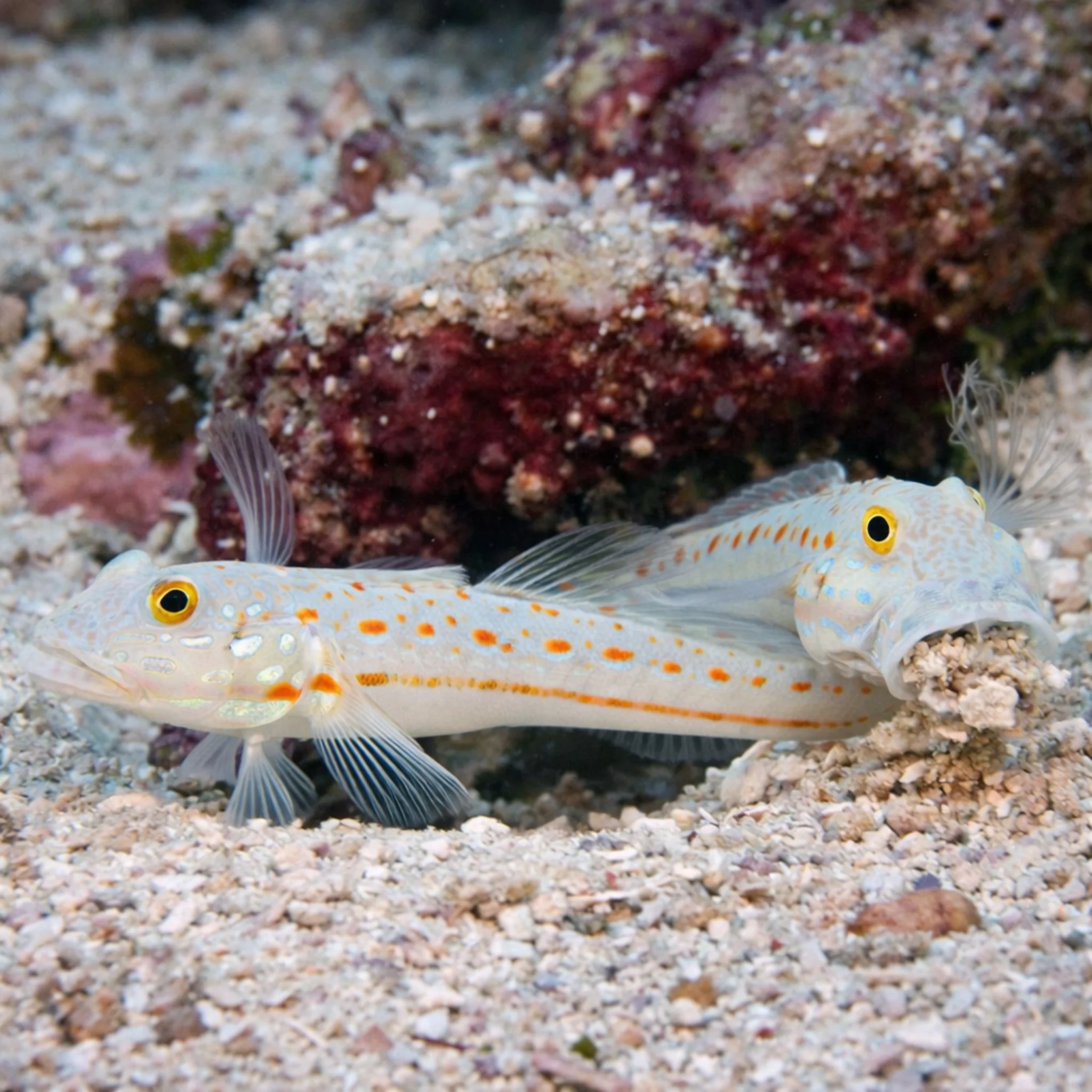
The Orange Spot Goby is a striking sand-sifting goby with a pale body marked by bold orange spotting and fine blue facial markings. In the wild it inhabits sandy lagoon and seaward reef areas, where it is often seen in pairs and uses shallow burrows for shelter. In the aquarium it can be a beautiful and useful substrate worker, but it needs a mature sand bed, frequent feeding and stable conditions, so it is better suited to aquarists with some marine experience.
Common Name:
Orange Spot Goby. It is also commonly known as the Orange-spotted Sleeper Goby or Maiden Goby.
Scientific Name (Latin):
Valenciennea puellaris
Maximum Size:
Up to 14 cm in captivity is a sensible aquarium reference, although larger scientific maximum lengths are recorded.
Water Type:
Marine.
Origin / Natural Habitat:
Widespread across the Indo-Pacific, from the Red Sea to Samoa, north to southern Japan and south to the Great Barrier Reef and New Caledonia. It inhabits sandy areas of clear lagoons and seaward reefs, usually in shallow to moderate reef depths.
Water Parameters:
Temperature: 22–28°C
pH Range: 8.1–8.4
Salinity: 1.020–1.025 SG
Temperament:
Generally peaceful, though it may quarrel with similar sand-sifting gobies, especially other members of the same genus. It is best kept with calm tankmates and, where possible, as a compatible pair rather than mixed with similar gobies.
Diet:
Carnivorous / micro-predatory sand sifter. It naturally feeds by taking in sand and extracting tiny invertebrates and other edible organisms. In captivity, its diet should be supported with small meaty frozen foods such as mysis and similar foods, offered several times daily.
Minimum Tank Size:
500 litres minimum is the safer long-term recommendation, especially as this species depends on a mature sand bed and does best with a generous footprint and established microfauna.
Behaviour & Activity:
This species spends much of the day sifting sand, excavating or maintaining shallow burrows, and hovering close to its chosen area of substrate. It is often seen in pairs and can move a surprising amount of sand around the aquarium.
Reef Safe:
Reef Safe
It is generally suitable for reef aquaria, but caution is sensible because it may eat smaller bristleworms, reduce sand-bed microfauna, and can dump sand onto low-placed or delicate corals while sifting. Monitor carefully around corals placed on or near the substrate.
Special Requirements or Care Notes:
A deep, mature sand bed is essential, along with secure rockwork because this fish may dig beneath stones and coral bases. It is also a known jumper, so a tight-fitting lid is strongly recommended. One of the main long-term risks with this species is starvation in immature systems or tanks without enough natural food in the substrate.
Suitable for:
Intermediate to Experienced fishkeepers. That is the safest overall recommendation based on its feeding sensitivity, need for a mature sand bed, and the extra care often required during acclimation.
Availability:
Regular in trade.
Product Information
Product Information
Shipping & Returns
Shipping & Returns
Orange Spot Goby - Valenciennea puellaris
Orange Spot Goby - Valenciennea puellaris
Orange Spot Goby (Valenciennea puellaris)
The Orange Spot Goby is a striking sand-sifting goby with a pale body marked by bold orange spotting and fine blue facial markings. In the wild it inhabits sandy lagoon and seaward reef areas, where it is often seen in pairs and uses shallow burrows for shelter. In the aquarium it can be a beautiful and useful substrate worker, but it needs a mature sand bed, frequent feeding and stable conditions, so it is better suited to aquarists with some marine experience.
Common Name:
Orange Spot Goby. It is also commonly known as the Orange-spotted Sleeper Goby or Maiden Goby.
Scientific Name (Latin):
Valenciennea puellaris
Maximum Size:
Up to 14 cm in captivity is a sensible aquarium reference, although larger scientific maximum lengths are recorded.
Water Type:
Marine.
Origin / Natural Habitat:
Widespread across the Indo-Pacific, from the Red Sea to Samoa, north to southern Japan and south to the Great Barrier Reef and New Caledonia. It inhabits sandy areas of clear lagoons and seaward reefs, usually in shallow to moderate reef depths.
Water Parameters:
Temperature: 22–28°C
pH Range: 8.1–8.4
Salinity: 1.020–1.025 SG
Temperament:
Generally peaceful, though it may quarrel with similar sand-sifting gobies, especially other members of the same genus. It is best kept with calm tankmates and, where possible, as a compatible pair rather than mixed with similar gobies.
Diet:
Carnivorous / micro-predatory sand sifter. It naturally feeds by taking in sand and extracting tiny invertebrates and other edible organisms. In captivity, its diet should be supported with small meaty frozen foods such as mysis and similar foods, offered several times daily.
Minimum Tank Size:
500 litres minimum is the safer long-term recommendation, especially as this species depends on a mature sand bed and does best with a generous footprint and established microfauna.
Behaviour & Activity:
This species spends much of the day sifting sand, excavating or maintaining shallow burrows, and hovering close to its chosen area of substrate. It is often seen in pairs and can move a surprising amount of sand around the aquarium.
Reef Safe:
Reef Safe
It is generally suitable for reef aquaria, but caution is sensible because it may eat smaller bristleworms, reduce sand-bed microfauna, and can dump sand onto low-placed or delicate corals while sifting. Monitor carefully around corals placed on or near the substrate.
Special Requirements or Care Notes:
A deep, mature sand bed is essential, along with secure rockwork because this fish may dig beneath stones and coral bases. It is also a known jumper, so a tight-fitting lid is strongly recommended. One of the main long-term risks with this species is starvation in immature systems or tanks without enough natural food in the substrate.
Suitable for:
Intermediate to Experienced fishkeepers. That is the safest overall recommendation based on its feeding sensitivity, need for a mature sand bed, and the extra care often required during acclimation.
Availability:
Regular in trade.
Original: $33.89
-65%$33.89
$11.86Product Information
Product Information
Shipping & Returns
Shipping & Returns
Description
Orange Spot Goby (Valenciennea puellaris)
The Orange Spot Goby is a striking sand-sifting goby with a pale body marked by bold orange spotting and fine blue facial markings. In the wild it inhabits sandy lagoon and seaward reef areas, where it is often seen in pairs and uses shallow burrows for shelter. In the aquarium it can be a beautiful and useful substrate worker, but it needs a mature sand bed, frequent feeding and stable conditions, so it is better suited to aquarists with some marine experience.
Common Name:
Orange Spot Goby. It is also commonly known as the Orange-spotted Sleeper Goby or Maiden Goby.
Scientific Name (Latin):
Valenciennea puellaris
Maximum Size:
Up to 14 cm in captivity is a sensible aquarium reference, although larger scientific maximum lengths are recorded.
Water Type:
Marine.
Origin / Natural Habitat:
Widespread across the Indo-Pacific, from the Red Sea to Samoa, north to southern Japan and south to the Great Barrier Reef and New Caledonia. It inhabits sandy areas of clear lagoons and seaward reefs, usually in shallow to moderate reef depths.
Water Parameters:
Temperature: 22–28°C
pH Range: 8.1–8.4
Salinity: 1.020–1.025 SG
Temperament:
Generally peaceful, though it may quarrel with similar sand-sifting gobies, especially other members of the same genus. It is best kept with calm tankmates and, where possible, as a compatible pair rather than mixed with similar gobies.
Diet:
Carnivorous / micro-predatory sand sifter. It naturally feeds by taking in sand and extracting tiny invertebrates and other edible organisms. In captivity, its diet should be supported with small meaty frozen foods such as mysis and similar foods, offered several times daily.
Minimum Tank Size:
500 litres minimum is the safer long-term recommendation, especially as this species depends on a mature sand bed and does best with a generous footprint and established microfauna.
Behaviour & Activity:
This species spends much of the day sifting sand, excavating or maintaining shallow burrows, and hovering close to its chosen area of substrate. It is often seen in pairs and can move a surprising amount of sand around the aquarium.
Reef Safe:
Reef Safe
It is generally suitable for reef aquaria, but caution is sensible because it may eat smaller bristleworms, reduce sand-bed microfauna, and can dump sand onto low-placed or delicate corals while sifting. Monitor carefully around corals placed on or near the substrate.
Special Requirements or Care Notes:
A deep, mature sand bed is essential, along with secure rockwork because this fish may dig beneath stones and coral bases. It is also a known jumper, so a tight-fitting lid is strongly recommended. One of the main long-term risks with this species is starvation in immature systems or tanks without enough natural food in the substrate.
Suitable for:
Intermediate to Experienced fishkeepers. That is the safest overall recommendation based on its feeding sensitivity, need for a mature sand bed, and the extra care often required during acclimation.
Availability:
Regular in trade.